Free AI APIs in 2026
Free AI APIs in 2026 is not exclusive to major tech companies anymore. Currently, developers, startups, and even students can add AI components to web pages, apps, and software solutions using APIs. With the emergence of free AI APIs, the availability of cutting-edge technology tools has never been easier.
By 2026, the AI industry continues to grow exponentially. Whether you need a solution for generating text, creating images, speech recognition, or getting help in programming, you do not have to pay thousands of dollars for implementing these technologies.
This article will explore some of the best free AI APIs available in 2026. We will discuss how they work, pros, cons, and how to get started with free APIs.
What Are AI APIs?
An AI API is a service that allows applications to communicate with an artificial intelligence model through a set of requests and responses.
Instead of building and training a machine learning model from scratch, developers can connect to an existing AI platform and use its capabilities within their own applications.
Common AI API functions include:
- Text generation
- Chatbots
- Language translation
- Image generation
- Speech recognition
- Text-to-speech conversion
- Sentiment analysis
- Data extraction
- Code generation
AI APIs simplify development by allowing businesses and individuals to focus on building products rather than managing complex AI infrastructure.
Why Free AI APIs Are Popular in 2026
Several factors have contributed to the popularity of free AI APIs:
Lower Development Costs
Developers can test ideas without paying for expensive AI infrastructure.
Faster Product Development
Teams can launch products quickly using ready-made AI services.
Learning Opportunities
Students and beginners can experiment with AI technology without financial risk.
Startup-Friendly Solutions
Early-stage startups often use free AI API tiers to validate products before upgrading to paid plans.
Easy Integration
Most providers offer detailed documentation and SDKs for multiple programming languages.
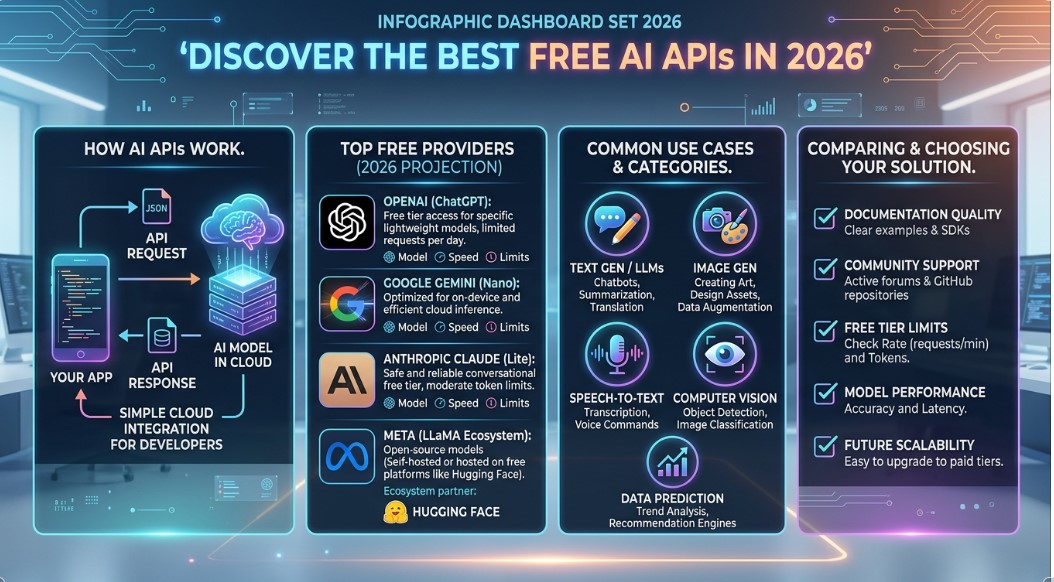
How AI APIs Work
The process is straightforward:
- Create an account with an AI provider.
- Generate an API key.
- Send requests from your application.
- Receive AI-generated responses.
- Display results to users.
For example, a chatbot application sends a user’s question to an AI API. The API processes the request and returns a response generated by its language model.
Best Free AI APIs in 2026
OpenAI API
OpenAI remains one of the most widely used AI providers.
Features include:
- Conversational AI
- Content generation
- Coding assistance
- Data analysis
- Language translation
Benefits:
- High-quality responses
- Strong developer ecosystem
- Extensive documentation
Ideal for:
- Chatbots
- Content tools
- SaaS applications
- Productivity software
Google Gemini API
Google’s Gemini API has become increasingly popular among developers.
Key features include:
- Text generation
- Image understanding
- Multimodal AI
- Research assistance
Advantages:
- Strong integration with Google services
- Excellent reasoning capabilities
- Developer-friendly tools
Best for:
- AI assistants
- Educational platforms
- Enterprise applications
Anthropic Claude API
Claude continues to gain attention due to its focus on safety and reasoning.
Notable capabilities:
- Long-context processing
- Content creation
- Business analysis
- Customer support automation
Strengths:
- Detailed responses
- Context awareness
- Reliable output quality
Suitable for:
- Business applications
- Knowledge management systems
- Customer service solutions
Hugging Face Inference API
Hugging Face offers access to thousands of open-source AI models.
Benefits include:
- Diverse model selection
- Community-driven ecosystem
- Flexible deployment options
Popular use cases:
- NLP projects
- Research applications
- Experimental AI tools
This platform is particularly attractive for developers who want greater control over model selection.
Cohere API
Cohere focuses heavily on natural language processing.
Capabilities:
- Text generation
- Classification
- Embeddings
- Search optimization
Advantages:
- Easy implementation
- High-quality language understanding
- Business-oriented features
Common applications:
- Search engines
- Recommendation systems
- Customer support tools
Groq API
Groq has attracted significant attention due to its speed.
Key highlights:
- Fast inference
- Competitive performance
- Growing developer ecosystem
Best suited for:
- Real-time applications
- Chatbots
- Interactive AI experiences
Stability AI API
For image generation projects, Stability AI remains a strong option.
Features:
- Image generation
- Image editing
- Creative design assistance
Ideal for:
- Graphic design tools
- Marketing applications
- Content creation platforms
DeepSeek API
DeepSeek has emerged as a notable AI provider offering advanced language models.
Strengths:
- Coding support
- Reasoning tasks
- Content generation
Popular among:
- Developers
- Startups
- Educational projects
Common Use Cases for Free AI APIs
AI Chatbots
Businesses use AI APIs to create customer support assistants that provide instant responses.
Content Writing Tools
Writers and marketers use AI APIs to generate drafts, outlines, and marketing copy.
Coding Assistants
Developers integrate coding models to improve productivity and automate repetitive tasks.
Language Translation
AI APIs help websites support multiple languages.
Voice Assistants
Speech recognition APIs enable voice-controlled applications.
Educational Platforms
Learning platforms use AI APIs for tutoring, quizzes, and personalized guidance.
Benefits of Using Free AI APIs
Accessibility
Anyone can start building AI-powered applications.
Scalability
Projects can grow without major infrastructure investments.
Reduced Complexity
Developers avoid the challenges of model training and maintenance.
Faster Innovation
Teams can focus on product features rather than machine learning engineering.
Limitations of Free AI APIs
While free AI APIs are valuable, they come with restrictions.
Usage Limits
Most providers limit monthly requests.
Rate Restrictions
Free tiers often have slower processing speeds.
Limited Features
Premium functionality may require paid plans.
Availability Concerns
Heavy demand can occasionally affect performance.
Understanding these limitations helps developers plan effectively.
Choosing the Right AI API
Consider the following factors:
Project Goals
Identify whether you need text, image, audio, or multimodal capabilities.
Documentation Quality
Good documentation reduces development time.
Performance
Evaluate speed and response quality.
Security
Ensure the provider follows proper security standards.
Scalability
Choose a service that can grow with your project.
AI API Integration Best Practices
Protect API Keys
Never expose API keys publicly.
Implement Error Handling
Prepare for failed requests and outages.
Monitor Usage
Track API consumption regularly.
Optimize Requests
Reduce unnecessary API calls.
Cache Responses
Store frequently used responses to improve efficiency.
Future of Free AI APIs
The AI industry is becoming increasingly competitive. As providers compete for developers and businesses, free tiers are expected to become more powerful.
Future trends include:
- Better reasoning models
- Faster response times
- More multimodal capabilities
- Lower costs
- Improved customization
Developers who begin experimenting today will be better positioned to take advantage of future innovations.
Frequently Asked Questions
Are free AI APIs really free?
Most providers offer free tiers with usage limits. Heavy usage usually requires a paid plan.
Which free AI API is best for beginners?
Google Gemini, OpenAI, and Hugging Face are excellent starting points due to their documentation and ease of use.
Can I build a chatbot using free AI APIs?
Yes. Many providers offer enough free usage for testing and small projects.
Do I need machine learning knowledge?
No. Most AI APIs are designed for developers with basic programming knowledge.
Are free AI APIs safe?
Reputable providers implement strong security measures, but developers should still protect API keys and user data.
Conclusion
The availability of free AI APIs in 2026 has changed the game for building intelligent apps. Whatever kind of application you want to create, whether a chatbot, a content creation platform, a code generator, an education app, or a business app, there are several choices of free AI APIs that you can use.
The important thing here is to pick the right vendor that fits your objectives, know the limitations of the free versions, and use proper practices when implementing the chosen API. With constant advancements in AI technology, the importance of using free AI APIs cannot be understated.
About the Author