biometric payments
The way people make has changed dramatically over the past decade. Cash transactions are increasingly being replaced by digital wallets, online banking, and contactless payment methods. Consumers now expect payment experiences that are not only fast but also highly secure and biometric payments.
As digital payments continue to evolve, a new technology is gaining significant attention: Biometric Payments.
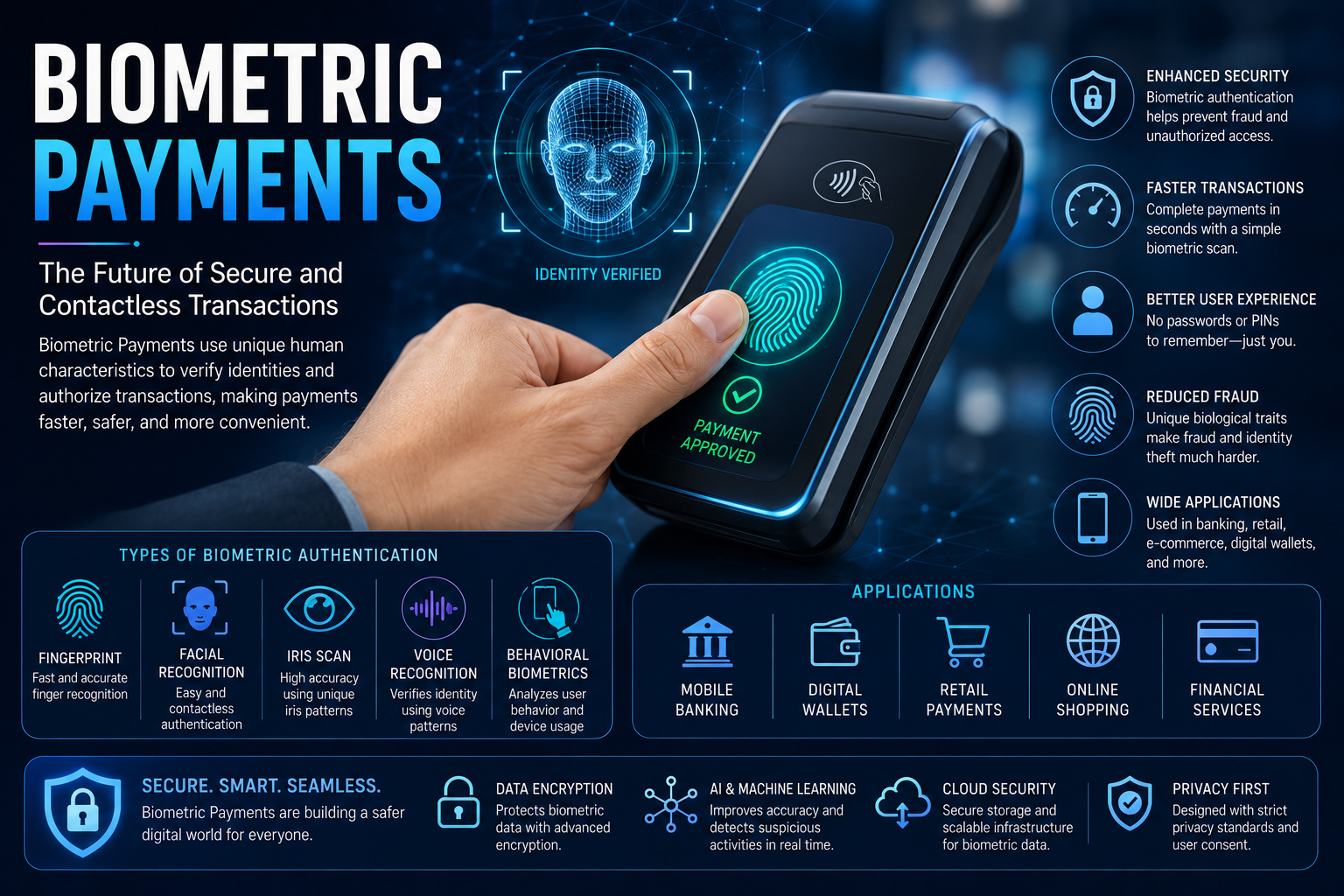
Biometric Payments use unique human characteristics such as fingerprints, facial recognition, iris scans, or voice patterns to verify identities and authorize transactions. Instead of entering passwords or PIN codes, users can complete payments using their biological features.
Powered by artificial intelligence, advanced sensors, and secure authentication technologies, Biometric Payments are transforming how businesses and consumers interact with financial services. From smartphones and banking applications to retail stores and smart devices, biometric authentication is becoming a key part of modern payment systems.
This guide explains everything you need to know about Biometric Payments, including how they work, their benefits, applications, challenges, and future trends.
What Are Biometric Payments?
Biometric Payments are payment systems that use biological characteristics to verify a person’s identity before approving transactions.
Unlike traditional authentication methods that rely on passwords or physical cards, biometric systems use unique human features that are difficult to duplicate.
Common forms of biometric authentication include:
- Fingerprint recognition
- Facial recognition
- Iris scanning
- Voice recognition
- Palm recognition
- Behavioral biometrics
The objective is to make transactions faster, safer, and easier for users.
Why Biometric Payments Matter
The global payment industry faces several challenges, including:
- Identity theft
- Payment fraud
- Password management issues
- Card theft
- Account takeovers
- Complex authentication processes
Traditional security methods often depend on information that can be forgotten, stolen, or compromised.
Biometric Payments solve many of these problems by using characteristics that are unique to each individual.
How Biometric Payments Work
Identity Enrollment
The process begins when users register their biometric information with a payment system.
Examples include:
- Fingerprint scanning
- Face registration
- Voice recording
- Iris mapping
The system converts this information into encrypted digital templates.
Secure Storage
Biometric information is stored securely using advanced encryption technologies.
Modern systems often store biometric templates rather than actual images or recordings.
Authentication Process
When making a payment, users provide biometric verification.
The system compares the new information with stored templates.
Payment Authorization
If the verification matches, the transaction is approved instantly.
If authentication fails, access is denied or additional verification may be required.
Types of Biometric Payments
Fingerprint Payments
Fingerprint recognition remains one of the most widely used biometric technologies.
Advantages include:
- Fast verification
- High accuracy
- Simple user experience
- Wide device compatibility
Facial Recognition Payments
Facial recognition systems analyze facial characteristics to verify identities.
Benefits include:
- Contactless authentication
- Improved convenience
- Quick payment approvals
Iris Recognition Payments
Iris scanning analyzes patterns within the human eye.
Advantages include:
- Extremely high accuracy
- Strong security
- Difficult to replicate
Voice Authentication
Voice recognition systems verify individuals using speech patterns and vocal characteristics.
This method is increasingly used in:
- Banking services
- Customer support
- Mobile applications
Behavioral Biometrics
Behavioral systems analyze patterns such as:
- Typing behavior
- Device interactions
- Navigation habits
- Touchscreen activities
These technologies provide additional security layers.
Technologies Behind Biometric Payments
Artificial Intelligence
Artificial intelligence improves recognition accuracy and continuously enhances authentication systems.
Machine Learning
Machine learning allows systems to adapt and improve over time.
Encryption Technologies
Encryption protects sensitive biometric information from unauthorized access.
Cloud Computing
Cloud platforms provide scalable infrastructure for storing and processing authentication data.
Mobile Technologies
Modern smartphones have accelerated biometric payment adoption through integrated sensors and secure processors.
Benefits of Biometric Payments
Enhanced Security
Biometric characteristics are unique and difficult to duplicate.
This significantly reduces fraud risks.
Faster Transactions
Payments can be completed within seconds.
Improved Convenience
Users no longer need to remember complex passwords or carry multiple payment cards.
Better User Experience
Simple authentication processes improve customer satisfaction.
Reduced Fraud
Biometric verification makes unauthorized transactions more difficult.
Applications of Biometric Payments
Mobile Banking
Banks increasingly use biometric authentication for:
- Account access
- Fund transfers
- Payment approvals
- Identity verification
Digital Wallets
Modern digital wallets use biometrics for secure transactions and user authentication.
Retail Payments
Retail businesses are adopting biometric technologies to create faster checkout experiences.
Online Shopping
E-commerce platforms increasingly use biometric authentication to improve payment security.
Financial Services
Financial institutions rely on biometrics for:
- Fraud prevention
- Customer identification
- Secure transactions
- Regulatory compliance
Smart Devices
Connected devices now support biometric payment capabilities through advanced authentication systems.
Biometric Payments and Artificial Intelligence
Artificial intelligence plays a major role in improving biometric technologies.
AI helps systems:
- Recognize patterns
- Improve verification accuracy
- Detect fraudulent activities
- Analyze user behavior
- Strengthen security mechanisms
As artificial intelligence technologies evolve, biometric systems are becoming increasingly reliable and intelligent.
Biometric Payments and Cybersecurity
Cybersecurity remains one of the biggest priorities in digital payment systems.
Biometric technologies improve cybersecurity through:
Strong Identity Verification
Unique characteristics make unauthorized access significantly more difficult.
Fraud Detection
Advanced analytics help identify suspicious activities.
Multi-Layer Security
Biometrics often work alongside encryption and additional authentication methods.
Continuous Monitoring
Modern systems continuously evaluate risks and improve protection mechanisms.
Challenges of Biometric Payments
Despite their advantages, biometric technologies also face challenges.
Privacy Concerns
Users often worry about how their biometric information is collected and stored.
Data Protection Requirements
Organizations must implement strong safeguards to protect sensitive information.
Implementation Costs
Developing biometric payment systems often requires substantial investments.
Technical Limitations
Recognition accuracy can occasionally be affected by environmental factors and hardware limitations.
Regulatory Compliance
Businesses must comply with evolving privacy and financial regulations.
Future Trends in Biometric Payments
Contactless Payment Growth
Consumers increasingly prefer touch-free payment experiences.
Greater AI Integration
Artificial intelligence will continue improving accuracy and fraud prevention.
Multi-Modal Authentication
Future systems may combine multiple biometric methods for stronger security.
Wider Adoption Across Industries
Healthcare, retail, banking, and transportation sectors are expected to expand biometric payment implementations.
Increased Mobile Integration
Smartphones and wearable devices will continue driving adoption worldwide.
Why Businesses Should Invest in Biometric Payments
Organizations implementing biometric technologies can gain several advantages:
- Stronger security
- Better customer experiences
- Faster transactions
- Lower fraud risks
- Improved operational efficiency
- Enhanced customer trust
Companies that adopt advanced payment technologies early often position themselves more effectively for future digital transformation.
Frequently Asked Questions
What are Biometric Payments?
Biometric Payments are transactions that use unique biological characteristics such as fingerprints or facial recognition to verify identities and authorize payments.
Why are Biometric Payments important?
They improve security, reduce fraud, and create faster and more convenient payment experiences.
Where are Biometric Payments used?
They are widely used in banking, digital wallets, retail stores, online shopping platforms, and mobile applications.
Are Biometric Payments secure?
Modern systems use encryption, artificial intelligence, and multiple security layers to protect sensitive information.
What is the future of Biometric Payments?
The future includes greater artificial intelligence integration, wider adoption, contactless experiences, and increasingly advanced authentication technologies.
Conclusion
Biometric Payments represent one of the most significant innovations in the financial technology industry. By combining artificial intelligence, advanced authentication methods, and secure digital infrastructures, they provide faster, safer, and more convenient payment experiences.
As consumers increasingly demand secure and frictionless transactions, Biometric Payments are expected to become a fundamental component of the global digital economy. Organizations that embrace biometric technologies today will likely be better prepared for the future of financial services and digital commerce.
About the Author