ambient security
The digital world has become more connected than ever before. People use smartphones, cloud services, smart devices, and online platforms throughout their daily lives. While these technologies have improved convenience and productivity, they have also ambient security increased cybersecurity risks.
Traditional security methods often rely on passwords, manual monitoring, and reactive responses. However, cyber threats are becoming increasingly sophisticated and require smarter protection mechanisms. This challenge has given rise to a new approach known as Ambient Security.
Ambient refers to intelligent, continuous, and mostly invisible security systems that work in the background to identify threats, analyze behavior, and protect digital environments automatically. Instead of waiting for users to respond to security issues, Ambient Security proactively monitors systems and takes preventive actions.
Powered by artificial intelligence, machine learning, behavioral analytics, and connected technologies, Ambient Security is becoming one of the most important innovations in modern cybersecurity.
This guide explains everything you need to know about Ambient Security, including how it works, benefits, applications, challenges, and future trends.
What Is Ambient Security?
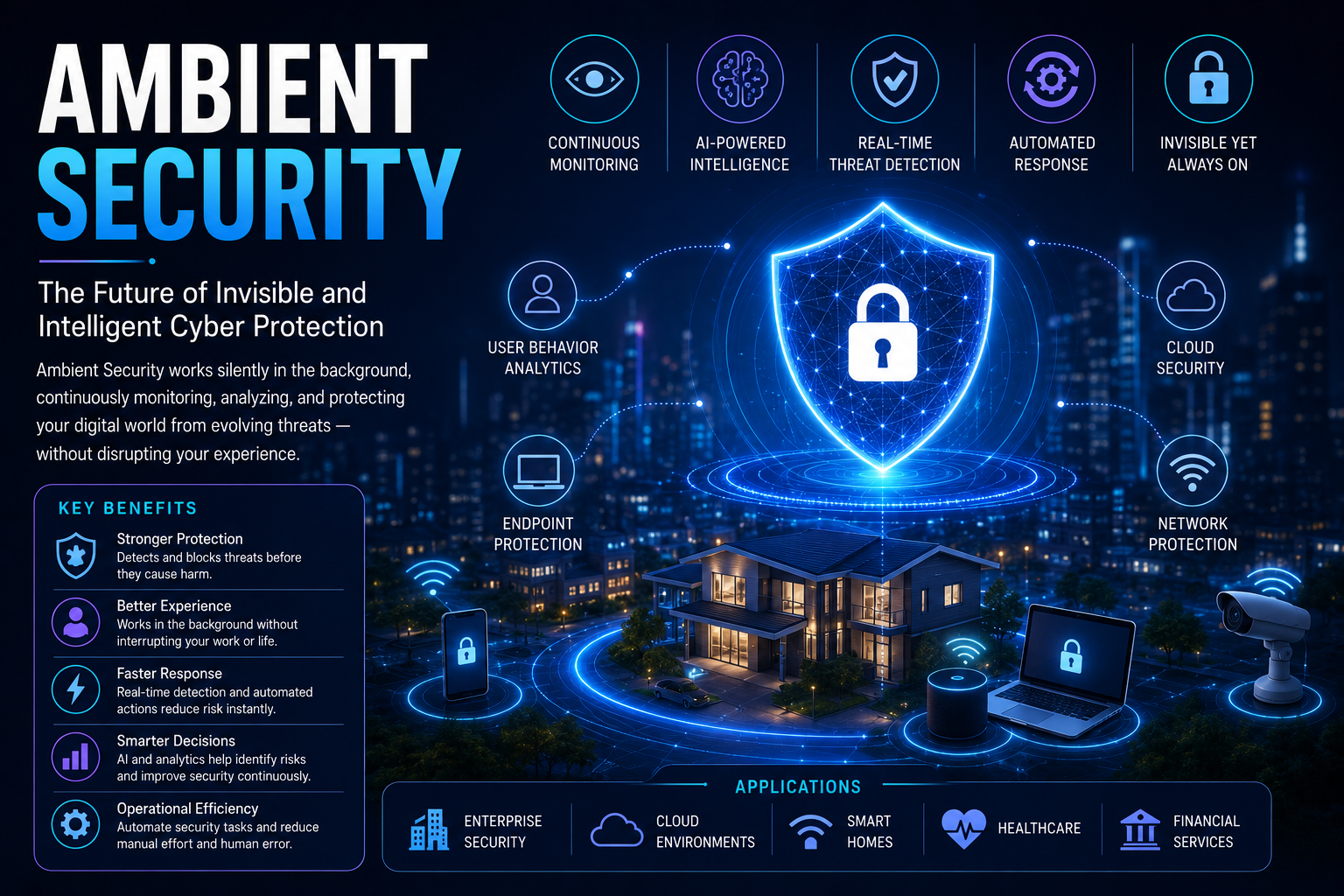
Ambient is a cybersecurity approach that continuously monitors users, devices, networks, and digital environments while operating quietly in the background.
Its primary goal is to provide seamless protection without disrupting user experiences.
Ambient Security focuses on:
- Continuous monitoring
- Intelligent threat detection
- Automated responses
- Behavioral analysis
- Real-time protection
- Context-aware security
Rather than relying entirely on manual security controls, Ambient Security enables systems to identify and respond to risks automatically.
Why Ambient Security Matters
Cyber threats are increasing rapidly across industries.
Organizations face challenges such as:
- Data breaches
- Ransomware attacks
- Identity theft
- Unauthorized access
- Insider threats
- Complex digital environments
Traditional security systems often struggle to detect sophisticated threats quickly.
Ambient addresses these challenges by providing proactive and intelligent protection.
How Ambient Security Works
Continuous Monitoring
The system continuously observes digital activities.
Examples include:
- User logins
- Device behavior
- Network traffic
- Application activities
- Access requests
Behavioral Analysis
Artificial intelligence studies patterns and identifies unusual activities.
Examples include:
- Unusual login locations
- Suspicious device behavior
- Abnormal system activity
- Unexpected data access
Risk Assessment
The system evaluates security risks and determines threat levels.
Automated Responses
When risks are detected, security mechanisms can automatically:
- Restrict access
- Verify identities
- Generate alerts
- Block suspicious activities
Continuous Learning
Machine learning algorithms improve security capabilities by learning from previous incidents and evolving threats.
Technologies Behind Ambient Security
Artificial Intelligence
Artificial intelligence enables systems to analyze information and identify potential threats.
Machine Learning
Machine learning improves detection accuracy by continuously learning from data.
Behavioral Analytics
Behavioral analytics helps security systems understand normal user activities and identify anomalies.
Cloud Computing
Cloud platforms provide scalable resources for monitoring and managing security information.
Internet of Things
Connected devices contribute additional information that helps create intelligent security environments.
Key Features of Ambient Security
Invisible Protection
Security operates quietly in the background with minimal user disruption.
Real-Time Threat Detection
Potential risks can be identified immediately.
Context Awareness
Security systems understand environments and adapt accordingly.
Automated Security Responses
Threats can be addressed without requiring manual intervention.
Adaptive Intelligence
Security systems continuously improve and become more effective over time.
Benefits of Ambient Security
Improved Cybersecurity
Continuous monitoring provides stronger protection against modern threats.
Better User Experiences
Users receive protection without dealing with complex security processes.
Faster Threat Detection
Potential attacks can be identified and addressed quickly.
Reduced Human Error
Automation minimizes mistakes caused by manual processes.
Enhanced Operational Efficiency
Organizations can manage security resources more effectively.
Applications of Ambient Security
Enterprise Security
Businesses use Ambient to:
- Protect sensitive information
- Monitor employee activities
- Secure digital infrastructure
- Prevent unauthorized access
Cloud Environments
Cloud platforms increasingly use intelligent security systems to:
- Monitor access requests
- Detect suspicious activities
- Protect information
- Improve compliance
Smart Homes
Connected home technologies use intelligent security systems for:
- Device monitoring
- Access management
- Threat detection
- Privacy protection
Healthcare
Healthcare organizations use advanced security systems to:
- Protect patient information
- Secure connected medical devices
- Monitor network activities
- Improve regulatory compliance
Financial Services
Banks and financial institutions apply Ambient for:
- Fraud detection
- Identity verification
- Transaction monitoring
- Risk management
Ambient Security and Artificial Intelligence
Artificial intelligence plays a major role in Ambient .
AI enables systems to:
- Analyze massive datasets
- Recognize patterns
- Predict threats
- Automate responses
- Improve decision-making
As artificial intelligence technologies continue advancing, intelligent security systems are becoming increasingly effective.
Ambient and Zero Trust Security
Ambient Security often complements Zero Trust Security principles.
Both approaches emphasize:
- Continuous verification
- Limited access permissions
- Real-time monitoring
- Risk-based decision-making
Together, they create stronger and more adaptive cybersecurity environments.
Challenges of Ambient Security
Although highly promising, Ambient Security faces several challenges.
Privacy Concerns
Continuous monitoring requires responsible information management.
Implementation Costs
Advanced security systems often require substantial investments.
Technical Complexity
Developing intelligent security environments demands specialized expertise.
Data Management
Security systems generate large volumes of information that require efficient processing.
Evolving Threats
Cybercriminals continuously develop new techniques that challenge security systems.
Future Trends in Ambient
Greater AI Integration
Artificial intelligence capabilities will continue improving threat detection and response.
Predictive Security
Security systems will increasingly predict threats before attacks occur.
Intelligent Automation
Automation technologies will handle more security responsibilities.
Expansion of Smart Environments
Connected homes, workplaces, and cities will increasingly rely on intelligent security systems.
Personalized Security Experiences
Security solutions will adapt according to individual users and environments.
Why Businesses Should Invest in Ambient Security
Organizations implementing intelligent security technologies can gain several advantages:
- Better protection against cyber threats
- Improved operational efficiency
- Faster threat response
- Enhanced customer trust
- Stronger regulatory compliance
- Reduced security risks
Companies that prioritize intelligent cybersecurity strategies are often better prepared for future digital challenges.
Frequently Asked Questions
What is Ambient ?
Ambient is a cybersecurity approach that continuously monitors digital environments and provides intelligent protection while operating in the background.
Why is Ambient important?
It improves cybersecurity, detects threats faster, and reduces reliance on manual security processes.
How does Ambient work?
It uses artificial intelligence, behavioral analytics, and continuous monitoring to identify risks and automate security responses.
Where is Ambient used?
It is widely used in businesses, cloud platforms, healthcare systems, financial services, and smart homes.
What is the future of Ambient?
The future includes predictive threat detection, greater automation, advanced artificial intelligence integration, and increasingly adaptive security systems.
Conclusion
Ambient Security represents the next evolution of cybersecurity. By combining artificial intelligence, machine learning, behavioral analytics, and continuous monitoring, it delivers intelligent and mostly invisible protection for modern digital environments.
As cyber threats become increasingly sophisticated, organizations and individuals require security solutions that can proactively identify risks and respond automatically. Ambient Security offers a powerful approach to protecting connected technologies and is expected to become one of the most important pillars of future cybersecurity strategies.
About the Author