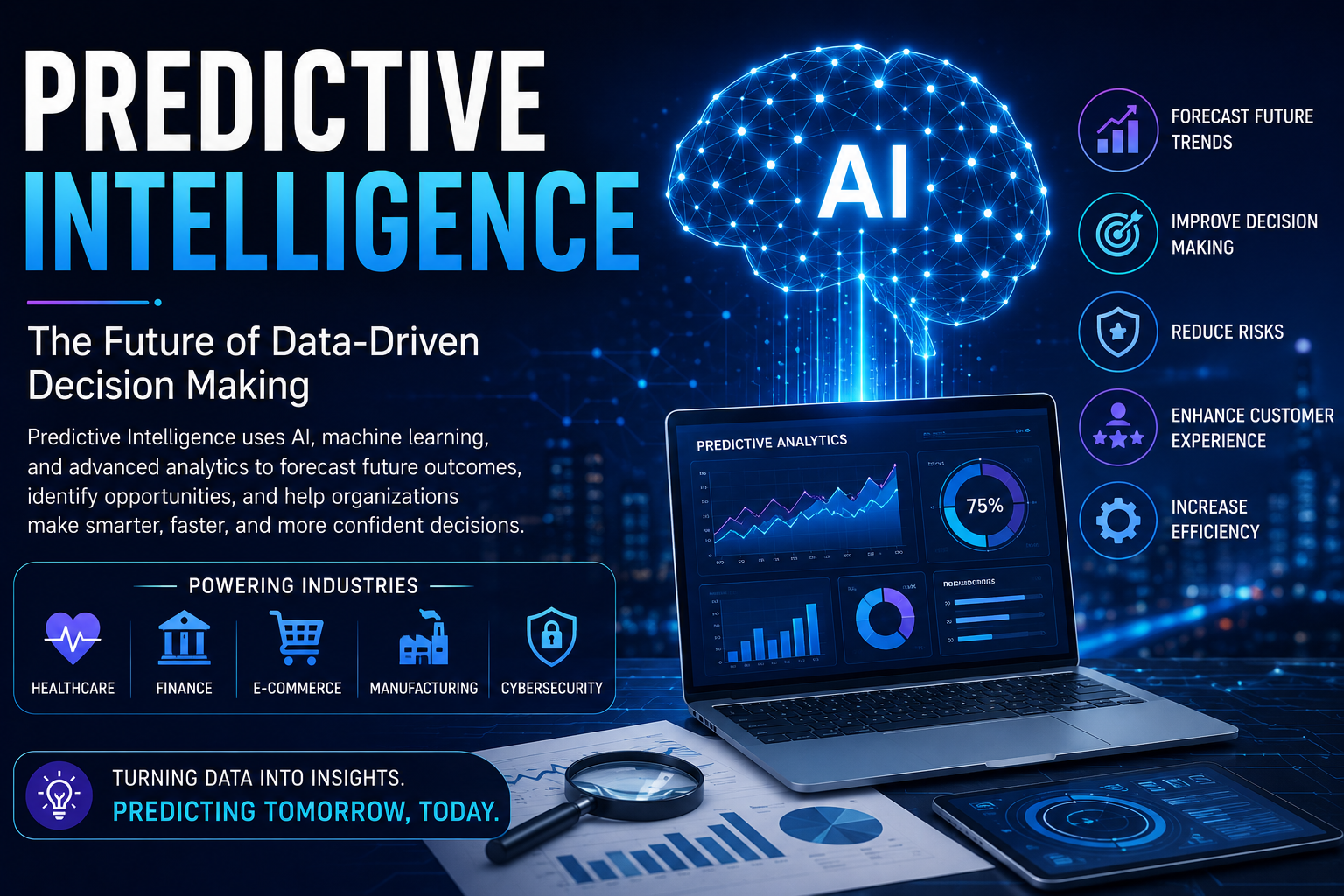
predictive intelligence
In today’s digital world, organizations generate enormous amounts of information every second. Businesses collect data from websites, mobile applications, social media platforms, customer interactions, and connected devices. The challenge is no longer collecting information but understanding predictive intelligence it and using it to make smarter decisions.
This is where Predictive Intelligence comes into play.
Predictive is an advanced approach that uses artificial intelligence, machine learning, historical information, and analytics to predict future outcomes and trends. Instead of simply analyzing past events, it helps organizations anticipate what may happen next and take proactive actions.
From healthcare and finance to e-commerce and cybersecurity, Predictive Intelligence is transforming industries by helping businesses improve efficiency, reduce risks, and deliver better customer experiences.
This guide explains everything you need to know about Predictive , including how it works, its benefits, applications, challenges, and future opportunities.
What Is Predictive?
Predictive is the process of using data, machine learning algorithms, and artificial intelligence technologies to forecast future events and generate actionable insights.
The main goal is to answer questions such as:
- What is likely to happen next?
- Which customers may purchase a product?
- What risks may occur?
- How can businesses improve performance?
- Which trends are emerging?
By identifying patterns and relationships in information, Predictive Intelligence helps organizations make informed decisions before situations occur.
Why Predictive Intelligence Matters
Modern businesses operate in highly competitive and rapidly changing environments.
Organizations often face challenges such as:
- Uncertain market conditions
- Customer behavior changes
- Operational risks
- Increasing competition
- Large volumes of information
Predictive helps organizations address these challenges by providing valuable insights and future forecasts.
How Predictive Intelligence Works
Data Collection
The process begins by collecting information from multiple sources.
Examples include:
- Customer transactions
- Website activity
- Mobile applications
- Social media platforms
- Business operations
- Connected devices
Data Processing
Collected information is organized and prepared for analysis.
This stage involves:
- Cleaning data
- Removing errors
- Organizing information
- Identifying patterns
Machine Learning Models
Artificial intelligence algorithms analyze information and discover relationships that humans may not easily recognize.
Predictions and Insights
The system generates forecasts and recommendations that help organizations make proactive decisions.
Continuous Improvement
Predictive systems continue learning as new information becomes available, making future predictions increasingly accurate.
Technologies Behind Predictive Intelligence
Artificial Intelligence
Artificial intelligence allows systems to analyze information and make intelligent predictions.
Machine Learning
Machine learning enables systems to improve automatically through experience and data analysis.
Big Data Analytics
Advanced analytics technologies process massive amounts of information efficiently.
Cloud Computing
Cloud platforms provide scalable infrastructure for storing and processing large datasets.
Data Visualization
Visualization tools help organizations understand predictive insights more effectively.
Benefits of Predictive Intelligence
Better Decision-Making
Organizations can make informed decisions based on future predictions rather than assumptions.
Improved Customer Experiences
Businesses can understand customer preferences and deliver personalized services.
Risk Reduction
Predictive technologies help identify potential problems before they become major issues.
Increased Efficiency
Organizations can optimize processes and allocate resources more effectively.
Higher Revenue Opportunities
Businesses can identify growth opportunities and improve strategic planning.
Applications of Predictive
Business and Marketing
Companies use Predictive Intelligence to:
- Understand customer behavior
- Personalize recommendations
- Improve advertising campaigns
- Increase customer retention
- Forecast sales trends
Healthcare
Healthcare organizations apply predictive technologies for:
- Disease prediction
- Patient monitoring
- Treatment planning
- Resource management
- Preventive care
Financial Services
Financial institutions use Predictive Intelligence for:
- Fraud detection
- Risk assessment
- Credit analysis
- Investment planning
- Market forecasting
Cybersecurity
Security teams rely on predictive technologies to:
- Detect suspicious activities
- Identify vulnerabilities
- Prevent cyberattacks
- Improve threat management
Manufacturing
Manufacturing companies use predictive systems for:
- Equipment monitoring
- Predictive maintenance
- Production planning
- Quality management
E-Commerce
Online businesses use predictive technologies to:
- Recommend products
- Understand buying behavior
- Improve inventory management
- Enhance customer experiences
Predictive Intelligence and Artificial Intelligence
Artificial intelligence serves as the foundation of Predictive .
AI enables systems to:
- Analyze large datasets
- Recognize patterns
- Learn continuously
- Predict outcomes
- Automate decisions
As artificial intelligence technologies continue evolving, predictive systems are becoming increasingly accurate and valuable.
Predictive Intelligence and Big Data
Predictive Intelligence and Big Data are closely connected.
Large amounts of information provide the foundation for creating accurate predictions.
Big Data technologies help organizations:
- Store information efficiently
- Process massive datasets
- Identify relationships
- Generate meaningful insights
Together, these technologies create powerful decision-making systems.
Challenges of Predictive Intelligence
Although highly promising, Predictive also presents challenges.
Data Quality Issues
Poor-quality information can reduce prediction accuracy.
Privacy Concerns
Organizations must handle information responsibly and protect sensitive data.
Implementation Costs
Advanced predictive technologies often require significant investment.
Technical Complexity
Building predictive systems demands specialized skills and expertise.
Ethical Considerations
Organizations must ensure predictions are used responsibly and fairly.
Future Trends in Predictive
More Advanced AI Models
Artificial intelligence systems will continue becoming more accurate and capable.
Real-Time Predictions
Organizations increasingly require immediate insights and automated decision-making.
Greater Personalization
Businesses will deliver increasingly customized experiences.
Predictive Automation
Automation technologies will increasingly rely on predictive capabilities.
Wider Industry Adoption
Predictive Intelligence is expected to become essential across healthcare, finance, manufacturing, retail, and numerous other sectors.
Why Businesses Should Invest in Predictive
Organizations adopting predictive technologies can gain several advantages:
- Improved competitiveness
- Better customer experiences
- Reduced risks
- Faster decision-making
- Increased efficiency
- Greater innovation opportunities
Companies that embrace predictive technologies early often position themselves more effectively for future growth.
Frequently Asked Questions
What is Predictive ?
Predictive Intelligence uses artificial intelligence, machine learning, and analytics to forecast future events and generate actionable insights.
Why is Predictive important?
It helps organizations make informed decisions, reduce risks, and improve efficiency.
Where is Predictive used?
It is widely used in healthcare, finance, cybersecurity, marketing, manufacturing, and e-commerce.
How does Predictive work?
It collects information, analyzes patterns, applies machine learning models, and generates predictions and recommendations.
What is the future of Predictive Intelligence?
The future includes advanced AI models, real-time predictions, predictive automation, and wider adoption across industries.
Conclusion
Predictive is transforming how organizations make decisions in the digital age. By combining artificial intelligence, machine learning, Big Data, and analytics, it enables businesses to anticipate future trends and take proactive actions.
As data volumes continue growing and industries become increasingly competitive, Predictive Intelligence is expected to become one of the most valuable technologies shaping the future of digital transformation and intelligent decision-making.
About the Author