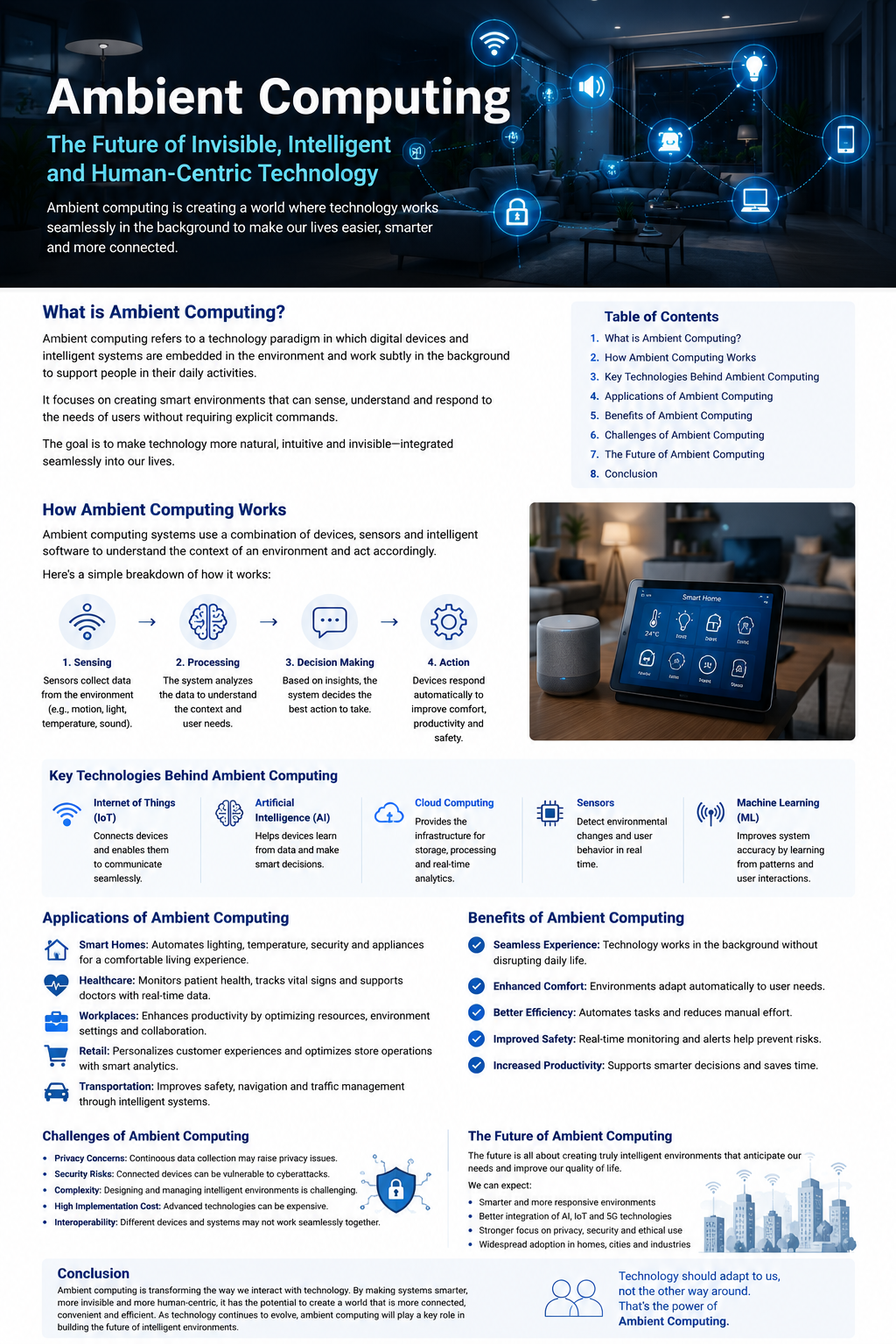
ambient computing
Technology has evolved rapidly over the past few decades. Computers became smartphones, smartphones became smart assistants, and today digital systems are becoming increasingly intelligent and interconnected. The next stage of technological evolution is known as Ambient Computing.
Ambient Computing represents a future where technology becomes almost invisible. Instead of requiring constant interaction with screens and devices, intelligent systems work quietly in the background, understanding users, predicting their needs, and providing services automatically.
Powered by artificial intelligence, cloud computing, sensors, and connected devices, Ambient Computing is transforming the relationship between humans and technology. From smart homes and wearable devices to intelligent workplaces and connected cities, this technology is creating seamless digital experiences.
This guide explores everything you need to know about Ambient Computing, including its working principles, benefits, applications, challenges, and future opportunities.
What Is Ambient Computing?
Ambient Computing refers to an environment where intelligent technologies work continuously in the background to provide personalized and context-aware experiences.
The goal is to make technology:
- Invisible
- Intelligent
- Predictive
- Personalized
- Context-aware
- Seamlessly connected
Rather than requiring users to manually operate devices, Ambient Computing enables systems to understand situations and respond automatically.
Why Ambient Computing Matters
Modern users expect technology to become faster, smarter, and easier to use.
Ambient Computing helps achieve these goals by:
- Reducing manual interactions
- Improving convenience
- Enhancing personalization
- Increasing productivity
- Delivering real-time assistance
- Creating seamless digital experiences
As digital transformation accelerates, Ambient Computing is becoming increasingly important across industries.
How Ambient Computing Works
Ambient Computing relies on several technologies working together.
Artificial Intelligence
Artificial intelligence analyzes information and makes intelligent decisions.
AI enables systems to:
- Recognize patterns
- Understand behavior
- Predict needs
- Improve experiences
Sensors and Connected Devices
Sensors continuously collect information from the surrounding environment.
Examples include:
- Motion sensors
- Location sensors
- Temperature sensors
- Wearable sensors
These devices help systems understand user activities and surroundings.
Cloud Computing
Cloud platforms provide storage and computing power for processing large amounts of information.
Benefits include:
- Real-time access
- Scalability
- Device synchronization
- Improved performance
Machine Learning
Machine learning allows systems to continuously improve by learning from previous interactions.
Over time, intelligent systems become increasingly personalized and efficient.
Key Characteristics of Ambient Computing
Context Awareness
Systems understand user environments and adapt accordingly.
Proactive Assistance
Technology can provide services before users request them.
Personalization
Experiences are customized according to preferences and behavior.
Continuous Connectivity
Devices remain connected and share information in real time.
Minimal User Interaction
The technology works quietly in the background with minimal effort from users.
Benefits of Ambient Computing
Improved Convenience
Users spend less time managing devices and more time focusing on important activities.
Better Productivity
Automation reduces repetitive tasks and improves efficiency.
Personalized Experiences
Intelligent systems adapt to individual preferences and routines.
Enhanced Decision-Making
Real-time information allows faster and more accurate decisions.
Greater Accessibility
Technology becomes easier to use for people with different abilities and needs.
Real-World Applications of Ambient Computing
Smart Homes
Modern homes increasingly use intelligent systems to:
- Adjust lighting
- Manage temperature
- Improve security
- Control entertainment systems
- Automate daily routines
Smart homes are among the most visible examples of Ambient Computing.
Healthcare
Healthcare organizations use intelligent technologies to:
- Monitor patient health
- Track vital signs
- Support diagnosis
- Improve patient care
Wearable devices and connected medical equipment are transforming healthcare delivery.
Smart Workplaces
Businesses use intelligent technologies to:
- Optimize office environments
- Improve collaboration
- Automate processes
- Enhance productivity
Connected workplaces help employees work more efficiently.
Retail Industry
Retail businesses use intelligent technologies to:
- Understand customer behavior
- Personalize recommendations
- Manage inventory
- Improve shopping experiences
Transportation
Transportation systems increasingly rely on intelligent technologies for:
- Navigation assistance
- Traffic management
- Vehicle monitoring
- Predictive maintenance
- Enhanced safety
Ambient and Artificial Intelligence
Artificial intelligence serves as the foundation of Ambient.
AI helps systems:
- Understand user behavior
- Process information
- Predict future needs
- Automate decisions
- Deliver personalized experiences
Without artificial intelligence, seamless ambient environments would not be possible.
Ambient Computing and the Internet of Things
The Internet of Things plays a major role in creating connected environments.
IoT devices include:
- Smart speakers
- Connected appliances
- Wearable devices
- Security systems
- Sensors and controllers
These devices continuously exchange information and create intelligent ecosystems.
Challenges of Ambient Computing
Although highly promising, Ambient faces several challenges.
Privacy Concerns
Intelligent systems often collect significant amounts of information.
Organizations must protect:
- Personal information
- User preferences
- Sensitive data
Cybersecurity Risks
Connected devices can become potential targets for cyberattacks.
Strong security practices are essential.
Technical Complexity
Building intelligent ecosystems requires advanced technologies and infrastructure.
High Implementation Costs
Developing and maintaining intelligent systems often requires substantial investment.
Data Management
Large volumes of information require efficient processing and storage solutions.
Future Trends in Ambient
More Intelligent Devices
Devices will become increasingly capable of understanding users and environments.
Greater Personalization
Experiences will become more customized and adaptive.
Edge Computing Integration
More processing will occur directly on devices, reducing delays and improving privacy.
Advanced Automation
Routine tasks will increasingly become automated.
Smart Cities
Urban environments will use intelligent technologies to improve transportation, energy management, and public services.
Why Businesses Should Pay Attention to Ambient Computing
Businesses adopting intelligent technologies may gain several advantages:
- Increased efficiency
- Better customer experiences
- Improved productivity
- Enhanced decision-making
- Competitive advantages
Organizations that embrace emerging technologies early often position themselves more effectively for long-term growth.
Frequently Asked Questions
What is Ambient?
Ambient Computing refers to intelligent technologies that work in the background and provide personalized, context-aware experiences with minimal user interaction.
How does Ambient work?
It combines artificial intelligence, sensors, cloud computing, machine learning, and connected devices to understand environments and automate responses.
Why is Ambient important?
It improves convenience, productivity, personalization, and overall digital experiences.
Where is Ambient used?
It is widely used in smart homes, healthcare, workplaces, retail, transportation, and connected cities.
What is the future of Ambient?
The future includes smarter devices, advanced automation, greater personalization, and increasingly intelligent digital environments.
Conclusion
Ambient represents one of the most exciting developments in modern technology. By combining artificial intelligence, connected devices, cloud platforms, and contextual awareness, it creates environments where technology becomes nearly invisible while remaining highly useful.
As businesses and consumers increasingly seek seamless digital experiences, Ambient Computing is expected to become a major driver of innovation. Organizations that understand and adopt this technology early may gain significant advantages in the rapidly evolving digital economy.
About the Author