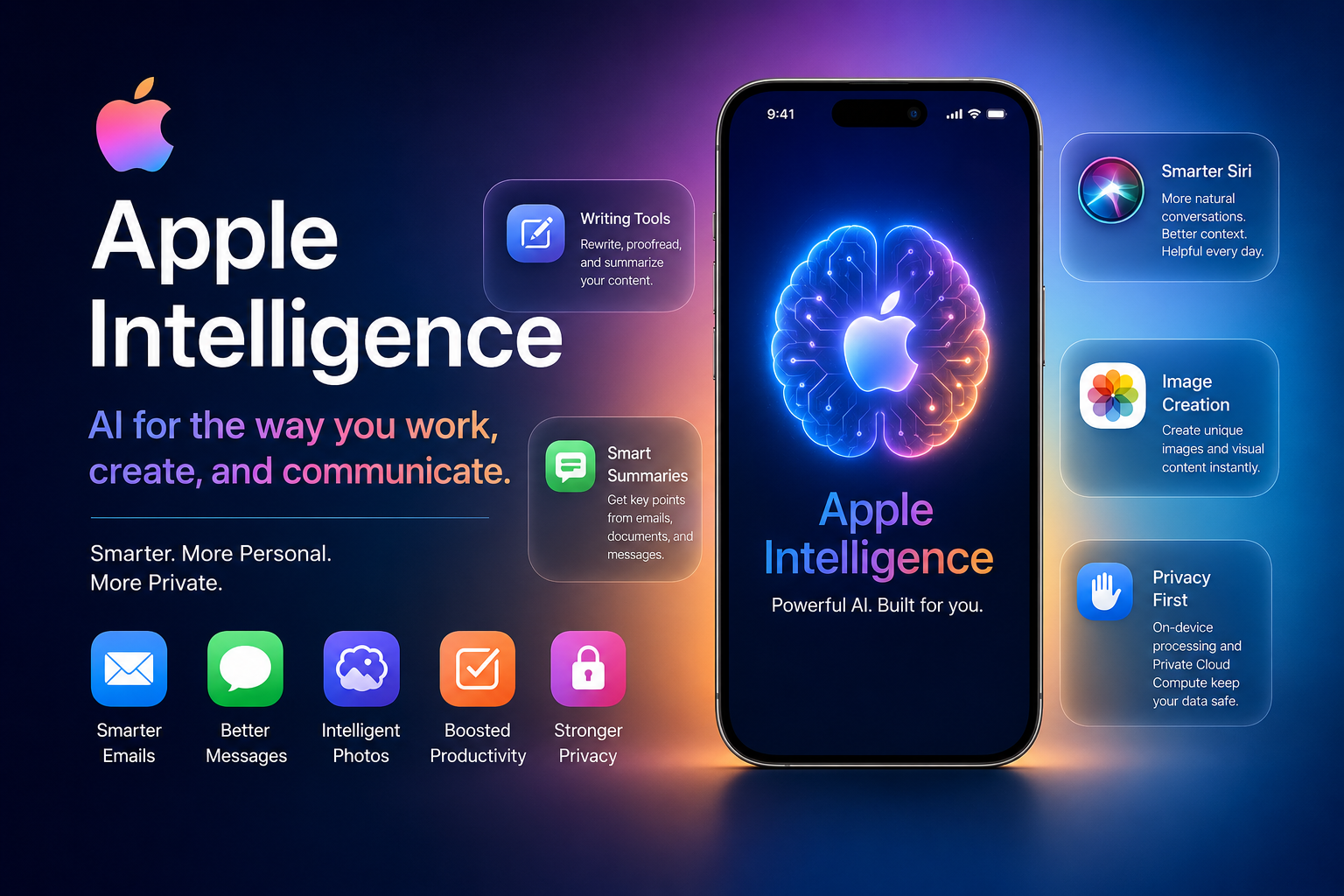
Apple Intelligence
Artificial intelligence has become one of the biggest technology trends of the decade. From AI chatbots and smart assistants to image generation and productivity tools, artificial intelligence is changing how people interact with technology. Apple has entered this space with its own AI platform known as Apple Intelligence.
Unlike many AI systems that focus primarily on cloud-based processing, Apple Intelligence combines powerful on-device intelligence with secure cloud computing to deliver a smarter and more private user experience. Apple designed this system to enhance productivity, communication, creativity, and daily tasks while maintaining its long-standing commitment to user privacy.
This comprehensive guide explores Apple Intelligence, its features, benefits, supported devices, privacy protections, and its impact on the future of Apple’s ecosystem.
What Is Apple Intelligence?
Apple Intelligence is Apple’s personal artificial intelligence system integrated across iPhone, iPad, and Mac devices.
The platform combines machine learning, natural language processing, and generative AI technologies to help users complete tasks more efficiently. Apple Intelligence works directly within apps and operating systems, making it easier for users to write, communicate, organize information, and perform daily activities.
Unlike traditional virtual assistants, Apple Intelligence understands context and personal preferences, enabling more useful and relevant responses.
Why Apple Created Apple Intelligence
Artificial intelligence has become an essential feature in modern technology. Companies such as OpenAI, Google, Microsoft, and Anthropic have introduced advanced AI systems that help users perform tasks faster and more efficiently.
Apple developed Apple Intelligence to:
- Improve user productivity
- Enhance communication
- Simplify daily tasks
- Strengthen privacy protections
- Create a smarter ecosystem
- Deliver AI features directly inside Apple devices
Instead of forcing users to install separate AI applications, Apple integrates intelligence directly into the operating system.
Key Features of Apple Intelligence
Writing Tools
One of the most useful features is the AI-powered writing assistant.
Users can:
- Rewrite text
- Correct grammar
- Improve sentence structure
- Change tone
- Summarize content
- Generate ideas
Whether writing emails, reports, blog posts, or messages, Apple Intelligence helps improve content quality.
Smart Summaries
Modern users receive large amounts of information every day.
Apple Intelligence can summarize:
- Emails
- Notifications
- Documents
- Articles
- Messages
These summaries save time and help users quickly understand important information.
Advanced Siri
Siri has received major improvements through Apple Intelligence.
The upgraded assistant offers:
- Better context awareness
- Natural conversations
- Faster responses
- Improved understanding
- Personalized assistance
Users can ask complex questions without repeating information multiple times.
Image Creation Tools
Apple Intelligence introduces AI-powered image generation capabilities.
Users can create:
- Custom illustrations
- Creative images
- Personalized graphics
- Visual content for projects
These tools help students, content creators, and professionals produce visual assets quickly.
Smart Photo Management
The Photos app benefits significantly from AI integration.
Features include:
- Automatic photo organization
- Intelligent search
- Enhanced editing tools
- Object recognition
- Smart albums
Finding specific photos becomes faster and easier.
Intelligent Notification Management
Too many notifications can become overwhelming.
Apple Intelligence helps by:
- Prioritizing important alerts
- Summarizing messages
- Reducing distractions
- Improving focus
Users receive a cleaner and more organized notification experience.
Apple Intelligence and Privacy
Privacy remains one of Apple’s strongest advantages.
Many AI platforms process large amounts of user data on external servers. Apple takes a different approach.
On-Device Processing
Many Apple Intelligence tasks occur directly on the device.
Benefits include:
- Faster performance
- Enhanced privacy
- Reduced data sharing
- Better security
Private Cloud Compute
For more advanced requests requiring additional processing power, Apple uses Private Cloud Compute.
This system:
- Protects user data
- Minimizes information storage
- Maintains transparency
- Enhances security
Apple states that personal information is not stored or sold for advertising purposes.
Supported Devices
Apple Intelligence requires modern hardware capable of handling advanced AI workloads.
Supported devices generally include:
iPhone
- Recent Pro models
- Future iPhone generations
iPad
- Apple Silicon iPads
- Newer iPad Pro models
- Select iPad Air devices
Mac
- Apple Silicon Macs
- M-series MacBooks
- Newer desktop Macs
Hardware requirements are important because AI features demand significant processing power.
Benefits of Apple Intelligence
Increased Productivity
AI-powered assistance helps users complete tasks more quickly.
Examples include:
- Drafting emails
- Summarizing documents
- Organizing schedules
- Managing information
Better Communication
Writing tools improve communication quality across messages, emails, and documents.
Enhanced Creativity
Image generation and content creation features support creative workflows.
Time Savings
Automation reduces repetitive tasks and improves efficiency.
Personalized Experiences
Apple Intelligence adapts to user behavior and preferences, creating more relevant recommendations.
Apple Intelligence for Students
Students can benefit significantly from Apple’s AI tools.
Use cases include:
- Research summaries
- Study guides
- Writing assistance
- Presentation preparation
- Note organization
These features help students improve productivity and learning outcomes.
Apple Intelligence for Professionals
Business users can leverage Apple Intelligence for:
- Email management
- Meeting preparation
- Content creation
- Project organization
- Workflow automation
Professionals can save valuable time and focus on strategic work.
Apple Intelligence for Content Creators
Content creators often manage large volumes of information and creative projects.
Apple Intelligence can assist with:
- Writing content
- Brainstorming ideas
- Creating visuals
- Editing text
- Organizing media files
These capabilities make content production more efficient.
Apple Intelligence vs Traditional AI Assistants
Traditional AI assistants often require users to switch between applications.
Apple Intelligence offers advantages such as:
- Deep operating system integration
- Better privacy controls
- Seamless user experience
- Faster access to information
- Device-level intelligence
This integration creates a smoother workflow across Apple’s ecosystem.
Potential Challenges
While Apple Intelligence offers many benefits, some limitations may exist.
Hardware Requirements
Older devices may not support all AI features.
Learning Curve
Users may need time to understand advanced AI capabilities.
Feature Availability
Certain functions may be released gradually across different regions.
Internet Dependency
Some advanced AI requests may require cloud processing.
Future of Apple Intelligence
Apple Intelligence is expected to evolve rapidly.
Future developments may include:
- More advanced Siri capabilities
- Better contextual understanding
- Enhanced productivity tools
- Smarter automation
- Improved multimodal AI features
- Deeper app integrations
As artificial intelligence becomes increasingly important, Apple Intelligence is likely to play a central role in Apple’s future strategy.
How Apple Intelligence Could Change Daily Life
The impact of Apple Intelligence extends beyond technology enthusiasts.
Everyday users may experience:
- Faster communication
- Smarter devices
- Better organization
- Increased productivity
- Improved digital experiences
AI is becoming a natural part of daily life, and Apple aims to make that transition seamless.
Frequently Asked Questions
What is Apple Intelligence?
Apple Intelligence is Apple’s AI platform that provides smart assistance, writing tools, image generation, summaries, and enhanced Siri functionality.
Is Apple Intelligence free?
Many features are expected to be included within supported Apple devices and operating system updates.
Does Apple Intelligence protect privacy?
Yes. Apple emphasizes privacy through on-device processing and Private Cloud Compute technologies.
Which devices support Apple Intelligence?
Support generally requires newer Apple Silicon devices and modern iPhone models.
Is Apple Intelligence better than traditional assistants?
It offers deeper integration with Apple devices, improved privacy, and enhanced productivity features.
Conclusion
Apple Intelligence represents a major milestone in Apple’s AI journey. By combining advanced artificial intelligence with strong privacy protections, Apple has created a platform that enhances productivity, communication, creativity, and everyday convenience.
From smarter writing tools and intelligent summaries to improved Siri capabilities and personalized experiences, Apple Intelligence is transforming how users interact with their devices. As Apple continues expanding its AI ecosystem, the platform is expected to become one of the most important features across iPhone, iPad, and Mac devices in the years ahead.
For users who value privacy, performance, and seamless integration, Apple Intelligence may define the future of personal computing within the Apple ecosystem.
About the Author