tinyml
Artificial intelligence has traditionally required powerful computers and cloud-based infrastructure to process large amounts of data. However, recent advancements in hardware and machine learning have introduced a revolutionary concept known as TinyML.
TinyML, short for Tiny Machine Learning, enables machine learning models to run directly on small, low-power devices such as sensors, wearables, microcontrollers, and smart appliances. Instead of relying entirely on cloud servers, these devices can process information locally and make intelligent decisions in real time.
As businesses and industries increasingly demand faster, more efficient, and privacy-focused technologies, TinyML is rapidly emerging as one of the most important innovations in modern computing. From healthcare and smart homes to industrial automation and environmental monitoring, TinyML is opening new possibilities for intelligent devices.
This guide explains everything you need to know about TinyML, including how it works, its benefits, applications, challenges, and future opportunities.
What Is TinyML?
TinyML is a technology that allows machine learning algorithms to run on extremely small and energy-efficient devices.
These devices usually include:
- Microcontrollers
- Sensors
- Wearable devices
- Smart appliances
- Internet of Things (IoT) devices
- Embedded systems
The goal of TinyML is to bring artificial intelligence directly to devices without requiring constant internet connectivity or expensive computing resources.
Why TinyML Matters
The number of connected devices worldwide continues to grow rapidly.
Traditional cloud-based artificial intelligence systems often face challenges such as:
- Network delays
- High bandwidth requirements
- Privacy concerns
- Increased operational costs
- Energy consumption
TinyML addresses many of these challenges by moving intelligence closer to the devices themselves.
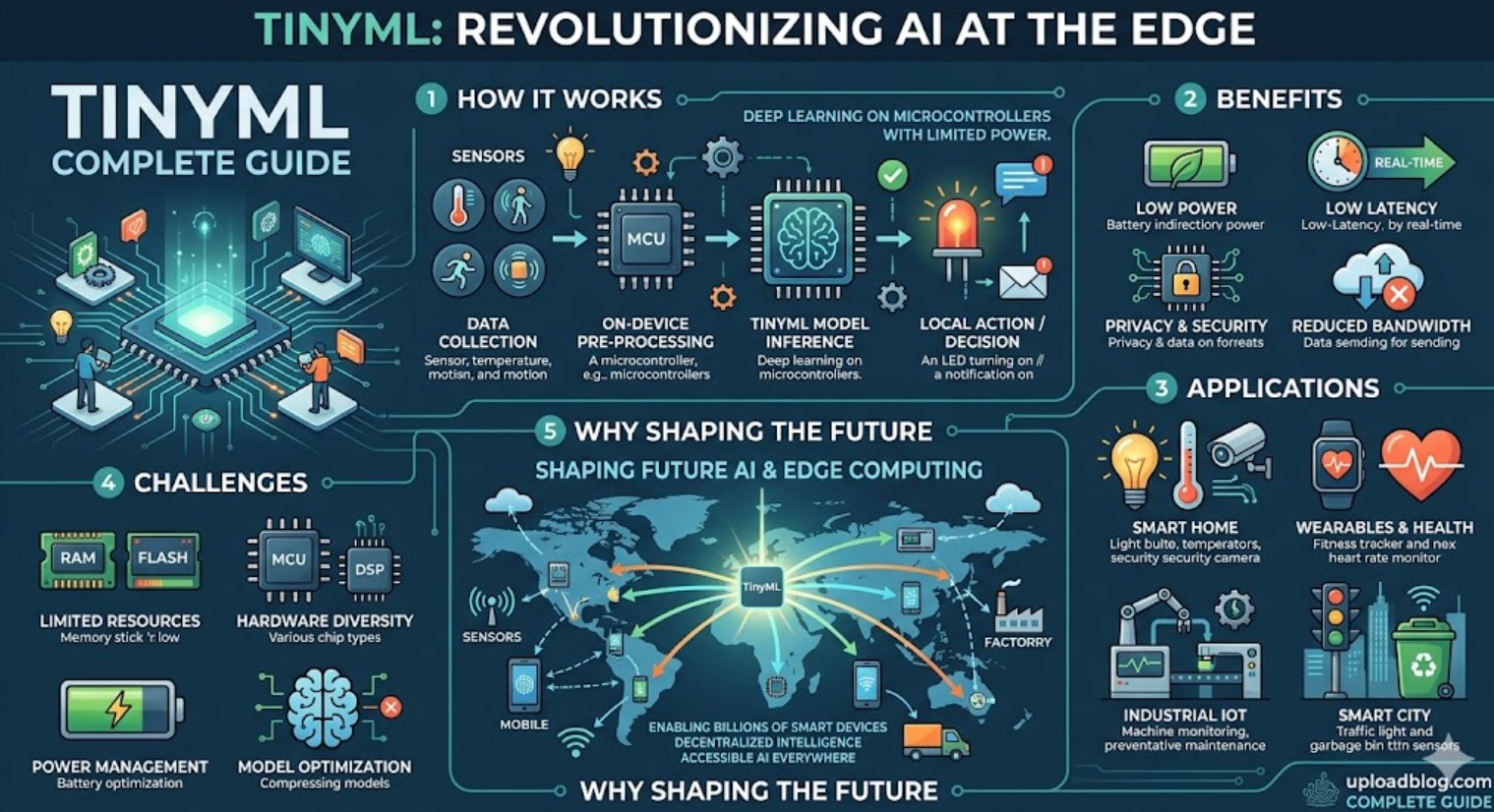
How TinyML Works
TinyML combines machine learning, embedded systems, and efficient hardware design.
Data Collection
Devices gather information through sensors.
Examples include:
- Temperature data
- Motion detection
- Voice inputs
- Images
- Environmental measurements
Model Training
Machine learning models are usually trained on more powerful computers using large datasets.
Model Optimization
The models are compressed and optimized to operate efficiently on small devices.
Local Processing
The optimized models run directly on devices and make decisions without depending entirely on cloud servers.
Key Technologies Behind TinyML
Machine Learning
Machine learning algorithms allow devices to identify patterns and make predictions.
Edge Computing
Edge computing processes information close to the source of data generation.
Benefits include:
- Lower latency
- Faster responses
- Improved efficiency
Internet of Things
TinyML and IoT work together to create intelligent connected systems.
Embedded Systems
Embedded hardware provides the computing power required to execute optimized machine learning models.
Benefits of TinyML
Lower Power Consumption
TinyML devices require significantly less energy compared to traditional computing systems.
This makes them ideal for battery-powered applications.
Faster Decision-Making
Local processing enables real-time responses and reduces delays.
Improved Privacy
Sensitive information can remain on the device rather than being transmitted to external servers.
Reduced Costs
Lower bandwidth usage and smaller hardware requirements help reduce operating expenses.
Offline Functionality
Many TinyML applications can continue functioning without internet connectivity.
Applications of TinyML
Smart Homes
TinyML enables smart home devices to:
- Detect activity
- Recognize voice commands
- Improve energy management
- Enhance security systems
Healthcare
Medical applications include:
- Health monitoring
- Wearable devices
- Early disease detection
- Patient tracking
Healthcare organizations increasingly rely on intelligent monitoring systems that can operate efficiently on small devices.
Industrial Automation
Manufacturing companies use TinyML for:
- Predictive maintenance
- Equipment monitoring
- Quality control
- Safety management
Environmental Monitoring
TinyML supports environmental solutions by:
- Monitoring air quality
- Detecting temperature changes
- Tracking water conditions
- Supporting disaster warning systems
Agriculture
Agricultural technologies use intelligent sensors to:
- Monitor soil conditions
- Improve irrigation systems
- Detect crop diseases
- Optimize resource management
Transportation
Transportation systems benefit from:
- Vehicle monitoring
- Predictive maintenance
- Traffic management
- Driver assistance systems
TinyML and Artificial Intelligence
TinyML represents a major evolution in artificial intelligence.
Traditional AI often depends heavily on cloud infrastructure.
TinyML introduces several advantages:
- Local intelligence
- Lower energy requirements
- Faster processing
- Greater privacy
- Improved scalability
As devices become smarter, TinyML is expected to play an increasingly important role in expanding AI adoption.
TinyML and Edge Computing
Edge computing and TinyML are closely connected technologies.
Both aim to process information near the data source rather than relying entirely on centralized cloud services.
This combination provides:
- Real-time analytics
- Reduced latency
- Enhanced reliability
- Better security
- Improved user experiences
Challenges of TinyML
Although highly promising, TinyML faces several challenges.
Hardware Limitations
Small devices often have limited memory and processing power.
Model Complexity
Developers must create highly efficient machine learning models.
Data Management
Collecting and managing quality datasets remains challenging.
Security Concerns
Connected devices may become targets for cyber threats.
Development Complexity
Building optimized machine learning solutions requires specialized expertise.
Future Trends in TinyML
Smarter IoT Devices
Connected devices will continue becoming more intelligent and autonomous.
Greater Healthcare Adoption
Wearable technologies and remote patient monitoring solutions are expected to expand rapidly.
Advanced Industrial Applications
Manufacturing environments will increasingly rely on intelligent monitoring systems.
Sustainable Computing
Low-power artificial intelligence technologies support energy-efficient computing.
Expansion of Edge AI
Artificial intelligence processing will increasingly move closer to users and devices.
Why Businesses Should Pay Attention to TinyML
Businesses adopting TinyML technologies can gain significant advantages.
Potential benefits include:
- Increased efficiency
- Better customer experiences
- Lower operational costs
- Faster decision-making
- Improved automation
- Enhanced security
Organizations that invest early in emerging technologies often position themselves more effectively for future innovation.
Frequently Asked Questions
What is TinyML?
TinyML is the process of running machine learning models on small, low-power devices such as microcontrollers and sensors.
Why is TinyML important?
It enables real-time intelligence, lower energy consumption, improved privacy, and reduced operational costs.
Where is TinyML used?
It is widely used in healthcare, smart homes, manufacturing, agriculture, environmental monitoring, and transportation.
Does TinyML require internet connectivity?
Many TinyML applications can operate without continuous internet access because processing occurs directly on devices.
What is the future of TinyML?
The future includes smarter devices, greater Edge AI adoption, advanced automation, and wider integration across industries.
Conclusion
TinyML is transforming the world of artificial intelligence by bringing machine learning capabilities directly to small and energy-efficient devices. By combining machine learning, edge computing, and embedded systems, TinyML enables faster, more private, and highly efficient intelligent experiences.
As industries continue adopting connected technologies and artificial intelligence solutions, TinyML is expected to become one of the most influential technologies shaping the future of smart devices and digital innovation.
About the Author